Questions 1-6 refer to the Bayesian network in Figure 1. Questions 7 and 8 refer to the Bayesian network in Figure 2.
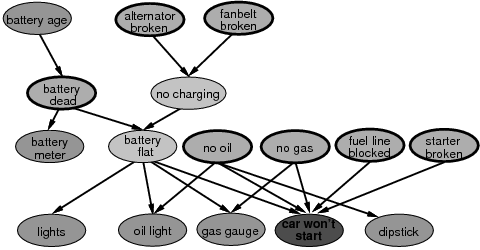
Figure 1: A Bayesian network graph establishing relations between various car problems and their causes.
On the network shown in Figure 1, consider the event E = "battery age is less than three years". Let A = P(E | "battery dead"=true AND "no oil"=true) and B = P(E | "battery dead"=true AND "no oil"=false). Which of the following three cases can possibly be true: A > B, A = B, or A < B? Why?
Answer: A = B, because the "battery age" variable and the "no oil" variable are conditionally independent given the value for the "battery age" variable.
On the network shown in Figure 1, consider again the event E = "battery age is less than three years". Let A = P(E | "battery dead"=true AND "no oil"=true) and B = P(E | "battery dead"=true AND "starter broken"=true). Which of the following three cases can possibly be true: A > B, A = B, or A < B? Why?
Answer: A = B, because the "battery age" variable and the "no oil" variable are conditionally independent given the value for the "battery age" variable, and the "battery age" variable and the "fanbelt broken" variable are also conditionally independent given the value for the "battery age" variable. Both A and B are equal to P(E | "battery dead" = true).
The "alternator broken" event and the "fanbelt broken" event are both causes of the "no charging event." Let A = P("alternator broken"=true | "no charging"=true) and B = P("alternator broken"=true | "no charging"=true AND "fanbelt broken"=true). Which of the following three cases do you expect to be true: A > B, A = B, or A < B? Why?
Answer: A > B. Since "alternator broken" and "fanbelt broken" are both causes of "no charging", given "no charging"=true, knowing that one cause is true makes the other cause less likely.
On the network shown in Figure 1, the "no gas" event is a cause of the "car won't start" event. Let A = P("no gas"=true) and B = P("no gas"=true | "car won't start"=true). Which of the following three cases do you expect to be true: A > B, A = B, or A < B? Why?
Answer: A < B. Since "no gas" is a cause of "car won't start", given "car won't start"=true, the cause for that becomes more likely.
On the network shown in Figure 1, suppose that:
Answer: We use the following abbreviations:
ncf stands for "no charging = false"
abt stands for "alternator broken = true"
abf stands for "alternator broken = false"
Using the above abbreviations, we have:
P(ncf) = P(ncf | abt) * P(abt) + P(ncf | abf) * P(abf)
= 0.05 * 0.02 + 0.99 * 0.98 = 0.9712
Suppose that:
Answer: We use the following abbreviations:
ba3 stands for "battery age <= 3 years"
ba4 stands for "battery age > 3 years"
bdt stands for "battery dead = true"
Using the above abbreviations, we have:
P(ba3 | bdt) = P(bdt | ba3) * P(ba3) / P(bdt) = 0.02 * 0.7 / P(bdt)

P(bdt) = P(bdt | ba3) * P(ba3) + P(bdt | ba4) * P(ba4)
= 0.02 * 0.7 + 0.1 * 0.3 = 0.044
Consequently, P(ba3 | bdt) = P(bdt | ba3) * P(ba3) / P(bdt) = 0.02 * 0.7 / 0.044 = 0.318.
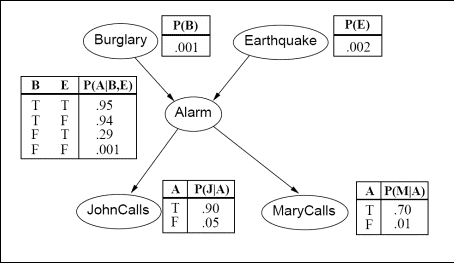
Figure 2: A Bayesian network establishing relations between events on the burglary-earthquake-alarm domain, together with complete specifications of all probability distributions.
On the network shown in Figure 2, what is the probability of the following event: burglary=false AND earthquake=true AND alarm=false AND JohnCalls=true AND MaryCalls=false.
Answer: We use the following abbreviations:
bf stands for "burglary = false"
et stands for "earthquake = true"
af stands for "alarm = false"
jt stands for "JohnCalls = true"
mf stands for "MaryCalls = false"
Using the above abbreviations, we have:
P(bf, et, af, jt, mf) = P(bf) *  P(et) * P(af | bf, et) * P(jt | af) * P(mf | af)
= (1 - 0.001) * 0.002 * (1 - 0.29) * 0.05 * (1-0.01) = 7.022 * 10-5
On the network shown in Figure 2, what is the probability of the following event: earthquake=true AND alarm=false AND JohnCalls=true AND MaryCalls=false.
Answer: We use the following abbreviations:
bf stands for "burglary = false"
bt stands for "burglary = true"
et stands for "earthquake = true"
af stands for "alarm = false"
jt stands for "JohnCalls = true"
mf stands for "MaryCalls = false"
Using the above abbreviations, we have:
P(et, af, jt, mf) = P(bf, et, af, jt, mf) + P(bt, et, af, jt, mf)
= P(bf) *  P(et) * P(af | bf, et) * P(jt | af) * P(mf | af) + P(bt) *  P(et) * P(af | bf, et) * P(jt | af) * P(mf | af)
= (1 - 0.001) * 0.002 * (1 - 0.29) * 0.05 * (1-0.01) + 0.001 * 0.002 * (1 - 0.95) * 0.05 * (1-0.01)
= 7.022 * 10-5 + 4.95 * 10-9